
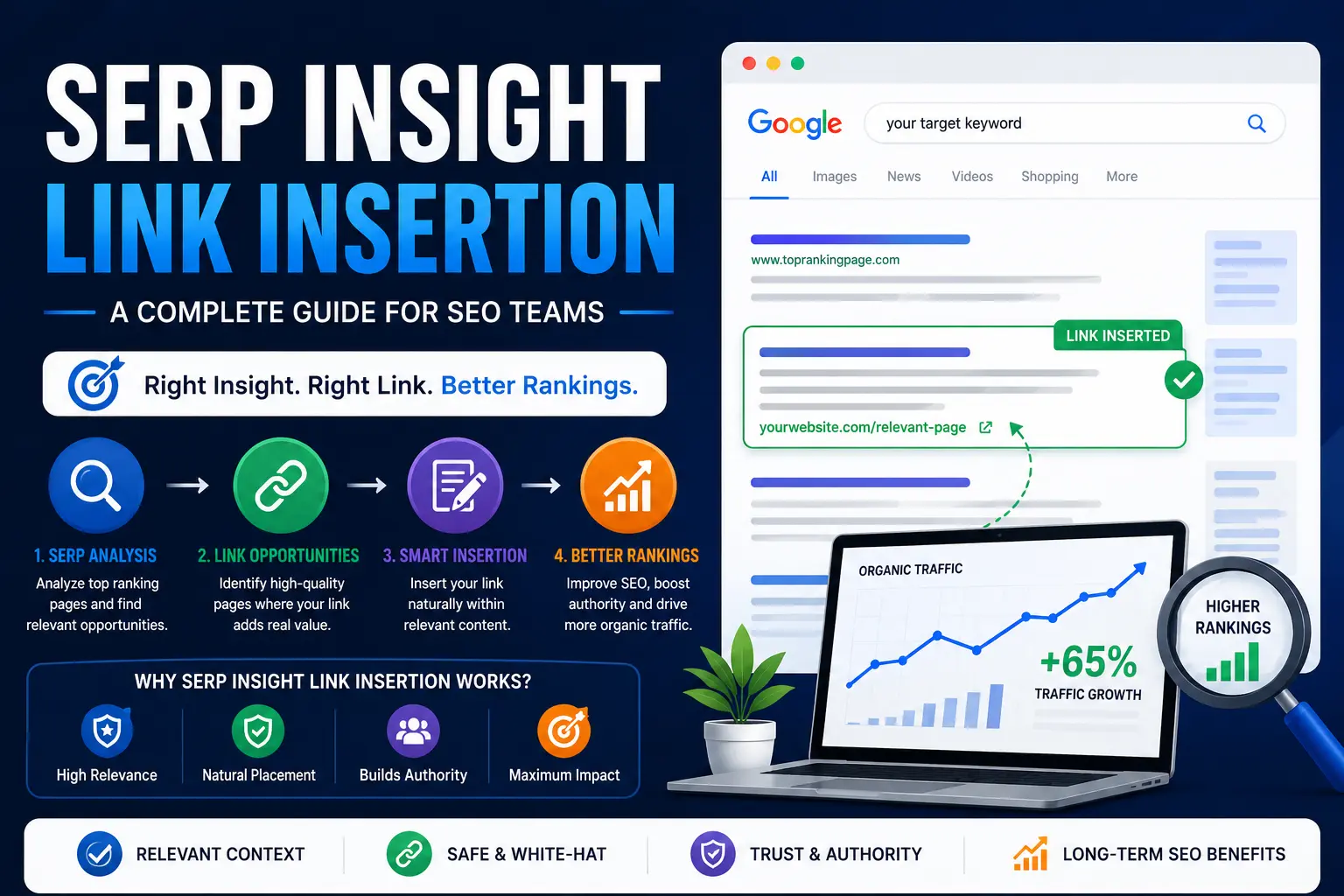
Building quality backlinks has never been easy. SEO professionals often spend weeks finding outreach opportunities, negotiating placements, publishing guest posts, and waiting for Google to index new pages. Even after all that effort, there’s no guarantee the links will improve keyword rankings.
SERP Insight Link Insertion offers a more strategic approach. Instead of choosing backlink opportunities based only on domain-level metrics like Domain Authority (DA) or Domain Rating (DR), this method uses real search engine data to identify pages that already perform well for keywords related to your niche.
By placing backlinks within these high-performing pages, businesses can strengthen topical authority, improve link relevance, and accelerate organic ranking growth. Since the content is already indexed and trusted by Google, backlinks can begin contributing value much sooner than newly published guest posts.
In this guide, you’ll learn what SERP Insight Link Insertion is, how the process works, and why many SEO teams are adopting this data-driven link-building strategy to improve search visibility in competitive industries.
What Is SERP Insight Link Insertion?
SERP Insight Link Insertion is an advanced link-building strategy that places backlinks inside existing, indexed webpages selected through search engine results page (SERP) analysis. Rather than focusing only on website authority metrics, this approach evaluates whether an individual page already ranks for keywords closely related to your target topic.
Think of it as an evolution of traditional niche edits. Conventional link insertions often prioritize high-authority websites without considering whether the specific page is relevant to your business. SERP Insight Link Insertion changes that by identifying pages Google already recognizes as authoritative within your niche.
The concept is straightforward:
If a webpage consistently ranks for keywords related to your industry, it has already earned topical trust from search engines. Adding your backlink naturally within that content allows your website to benefit from the page’s established relevance instead of relying solely on overall domain strength.
For example, imagine you’re promoting a project management platform. A backlink placed inside a page ranking for “best project management software” or “team collaboration tools” is typically more valuable than one from a generic technology article that has little connection to your topic.
Google evaluates backlinks based on context, content quality, and topical relationships—not just authority scores. That’s why page-level relevance often delivers stronger SEO signals than simply acquiring links from websites with high DR or DA.
Another major advantage is speed. Since the host page is already published, indexed, and receiving organic traffic, there’s no need to wait for Google to discover and evaluate new content. Your backlink becomes part of an established page that already carries search authority, helping reduce the delay commonly associated with guest posting campaigns.
How SERP Insight Link Insertion Works
A successful SERP Insight Link Insertion campaign follows a structured, research-driven process. Every placement is supported by keyword data and page-level analysis rather than assumptions, making the strategy more precise and scalable.
Step 1: Analyze the SERPs and Identify Relevant Opportunities
The process begins with keyword research.
Start by defining your primary keywords along with closely related search terms that support your SEO objectives. Next, examine Google’s search results to identify webpages already ranking for those queries.
The objective isn’t simply to find authoritative websites—it’s to locate pages that Google consistently rewards with strong rankings because they demonstrate topical relevance.
During this stage, evaluate factors such as:
- Primary and secondary keywords the page ranks for
- Current ranking positions
- Estimated organic traffic
- Traffic growth or decline over time
- Search intent alignment
- Overall content quality
Professional SEO platforms like Ahrefs, Semrush, and Surfer SEO simplify this research by providing detailed keyword rankings, traffic estimates, backlink data, and historical performance trends.
Pages that maintain stable rankings and consistent organic traffic generally offer stronger backlink opportunities than pages experiencing continuous ranking declines.
Step 2: Evaluate Page Quality Before Placement
Ranking alone shouldn’t determine whether a page deserves your backlink.
Every potential placement should undergo a thorough quality review to ensure the page provides genuine editorial value and aligns with your industry.
When reviewing a page, consider questions such as:
- Does the content thoroughly cover the topic?
- Is the information updated and well-maintained?
- Does the page receive meaningful organic traffic?
- Are outbound links relevant and naturally integrated?
- Does the website appear trustworthy and professionally managed?
Avoid pages overloaded with promotional links or unrelated outbound references. Even if these pages rank well temporarily, excessive linking can weaken contextual relevance and reduce the value your backlink receives.
The strongest candidates are comprehensive articles published on reputable websites that maintain editorial standards and attract consistent organic visitors.
Step 3: Place the Link Within Relevant Context
Once you’ve selected a high-quality page, the next step is integrating your backlink naturally into the existing content.
Context is one of the most important ranking signals in modern link building. Your backlink should enhance the reader’s experience by supporting the surrounding discussion rather than appearing as an obvious promotional addition.
The most effective placements typically occur where your resource expands on a topic already being discussed, allowing users to access additional information without interrupting the article’s flow.
Anchor text also deserves careful attention.
Instead of repeatedly using exact-match keywords, build a natural anchor text profile that includes:
- Brand names
- Partial-match keywords
- Descriptive phrases
- Generic anchors
- Natural language variations
This diversified approach helps maintain an organic backlink profile while strengthening topical relevance across your link-building campaign.
Step 4: Track Performance and Measure SEO Impact
After your backlink goes live, ongoing monitoring becomes essential.
A successful SERP Insight Link Insertion campaign doesn’t end with placement it continues through performance analysis and optimization.
Monitor important SEO metrics such as:
- Target keyword rankings
- Organic traffic growth
- Referral traffic from the host page
- Indexing status
- Backlink health
- Overall domain visibility
Because backlinks are placed on already indexed and trusted pages, many websites begin noticing ranking improvements within two to six weeks, depending on keyword competition and the strength of their overall SEO strategy.
Why SERP Insight Link Insertion Delivers Better SEO Results Than Traditional Link Building
Traditional link-building campaigns often rely on broad authority metrics, outreach volume, and content publication. While these tactics can generate backlinks, they don’t always produce meaningful ranking improvements. Many SEO teams invest significant time and budget into acquiring links without knowing whether the placement will actually influence their target keywords.
SERP Insight Link Insertion takes a more data-driven approach. Instead of assuming every high-authority website provides equal value, it focuses on pages that already rank for search queries closely related to your business. This shift from domain-level evaluation to page-level relevance creates stronger contextual signals that align with how modern search engines assess backlink quality.
Below are the key reasons this strategy consistently outperforms conventional link-building methods.
1. Stronger Topical Relevance
Search engines no longer evaluate backlinks based solely on website authority. They also consider whether the linking page is contextually related to the destination page.
SERP Insight Link Insertion prioritizes backlinks from pages that already rank within your keyword cluster. Because these pages have established topical authority, the backlink reinforces your content’s relevance instead of simply passing generic authority.
For example, if your website sells CRM software, a backlink from an article ranking for customer relationship management tools or sales automation software provides a much stronger contextual signal than a backlink from a general business or technology blog.
When both the linking page and destination page cover closely related topics, search engines gain greater confidence in your content’s expertise and relevance.
2. Faster Ranking Improvements
One of the biggest advantages of SERP Insight Link Insertion is speed.
Guest posts typically require multiple stages before they contribute SEO value:
- Content planning
- Writing and editing
- Publisher approval
- Publication
- Indexing
- Search engine evaluation
This process often takes several weeks or even months.
SERP Insight Link Insertion removes much of this waiting period because backlinks are added to pages that are already:
- Indexed by Google
- Receiving organic traffic
- Ranking for relevant keywords
- Trusted within their topic
Instead of waiting for a brand-new article to build authority, your backlink benefits from an existing page that has already established visibility in search results.
As a result, many campaigns begin showing measurable keyword movement within a few weeks rather than several months.
3. Better Link Equity Distribution
Not every backlink transfers the same amount of SEO value.
A page that ranks well for important keywords generally possesses stronger page-level authority than a page with little or no organic visibility.
SERP Insight Link Insertion focuses on pages that have already earned Google’s trust, increasing the likelihood that meaningful link equity flows to your website.
Rather than depending exclusively on domain metrics like Domain Rating (DR) or Domain Authority (DA), this strategy evaluates factors such as:
- Page rankings
- Organic keyword performance
- Search visibility
- Content quality
- Topical alignment
This produces backlinks that carry both authority and contextual relevance.
4. More Efficient Use of SEO Budgets
Content production represents one of the largest expenses in guest posting campaigns.
Each placement usually requires:
- Keyword research
- Content creation
- Editing
- Publisher revisions
- Formatting
- Publication management
SERP Insight Link Insertion eliminates most of these steps because the content already exists.
Instead of paying for new articles that may or may not rank, you’re investing in proven pages that already generate organic traffic and have demonstrated search performance.
This often makes the strategy more cost-efficient while delivering faster SEO outcomes.
5. Decisions Backed by Real Search Data
Many traditional outreach campaigns rely heavily on assumptions.
SEO teams often choose websites because they have:
- High Domain Authority
- Strong Domain Rating
- Large backlink profiles
- Popular brand recognition
While these metrics provide useful information, they don’t necessarily indicate whether an individual page contributes meaningful topical relevance.
SERP Insight Link Insertion replaces assumptions with measurable data by analyzing:
- Current SERP positions
- Keyword overlap
- Organic traffic trends
- Page-level authority
- Search intent alignment
Every placement is supported by evidence rather than estimates, making the campaign more predictable and scalable.
SERP Insight Link Insertion
This strategy combines contextual backlink placement with search performance analysis.
Instead of evaluating websites only by authority metrics, it identifies pages that already rank for relevant keywords and naturally integrates backlinks into those pages.
Its biggest advantages include:
- Strong topical relevance
- Faster implementation
- Existing search authority
- Better contextual signals
- Data-driven placement decisions
Because every backlink is supported by real SERP performance, campaigns tend to produce more consistent SEO improvements.
Guest Posting
Guest posting remains one of the most widely used link-building techniques.
It allows brands to publish entirely new articles on third-party websites while controlling the messaging, anchor text, and content structure.
However, guest posting also introduces several challenges.
New content must first:
- Be written
- Be approved
- Be published
- Get indexed
- Build authority
Only after these steps can the backlink begin influencing rankings.
Guest posting remains valuable for brand awareness, thought leadership, and referral traffic, but it generally requires more time and resources before delivering measurable SEO gains.
Traditional Niche Edits
Traditional niche edits insert backlinks into existing content, making them faster than guest posting.
However, many campaigns still prioritize metrics such as Domain Rating or Domain Authority without examining whether the specific page has meaningful search visibility.
This creates situations where backlinks are placed on:
- Low-traffic pages
- Outdated articles
- Thin content
- Pages that no longer rank
Although the website itself may appear authoritative, the individual page often contributes limited SEO value.
SERP Insight Link Insertion improves upon this approach by selecting pages based on actual search performance rather than domain-level statistics alone.
Common Risks of SERP Insight Link Insertion (And How to Avoid Them)
Like any SEO strategy, SERP Insight Link Insertion delivers the best results when executed responsibly.
Most risks arise from poor implementation rather than the methodology itself.
Understanding these potential issues helps protect your backlink profile and maintain long-term ranking stability.
Choosing Pages That Lack Topical Relevance
One of the most common mistakes is acquiring backlinks from pages that rank well but have little connection to your industry.
High rankings alone do not guarantee SEO value.
If the surrounding content doesn’t closely match your target topic, the backlink sends weaker relevance signals and may contribute little to organic growth.
Before placing any backlink, verify that the page:
- Covers similar topics
- Targets related keywords
- Matches user search intent
- Naturally supports your linked resource
Context should always take priority over authority metrics.
Overusing Exact-Match Anchor Text
Anchor text remains an important ranking signal, but excessive optimization can create an unnatural backlink profile.
Repeatedly using identical keyword-rich anchors increases the risk of appearing manipulative.
A healthier anchor profile includes a balanced mix of:
- Branded anchors
- Partial-match keywords
- Generic phrases
- Natural language anchors
- URL anchors
This diversification reflects how backlinks develop naturally across the web.
Building Links Too Aggressively
Even high-quality backlinks can raise concerns if they appear in unusually large numbers over a short period.
Search engines expect backlink growth to occur gradually.
Rather than acquiring dozens of placements at once, focus on consistent, sustainable link acquisition that mirrors natural growth patterns.
A steady campaign built around quality placements generally produces stronger long-term results than rapid bursts of link building.
Ignoring Ongoing Link Monitoring
Backlink acquisition shouldn’t end once the placement goes live.
Over time, webpages may:
- Lose rankings
- Remove links
- Change ownership
- Update content
- Decline in quality
Regular backlink audits help ensure your placements remain active and continue supporting your SEO goals.
Monitoring also allows you to identify opportunities for replacement or additional authority-building before rankings are affected.
Focusing on Quantity Instead of Quality
A smaller number of highly relevant backlinks often produces better SEO results than hundreds of weak placements.
Rather than measuring success by link volume, prioritize:
- Page-level relevance
- Organic traffic
- Editorial quality
- Search visibility
- User value
- Contextual placement
This quality-first mindset aligns closely with modern search engine algorithms and creates a stronger, more sustainable backlink profile over time.
Best Practices for SERP Insight Link Insertion
SERP Insight Link Insertion delivers the strongest results when it is integrated into a broader SEO strategy rather than treated as a standalone tactic. Every backlink should support your topical authority, reinforce your content strategy, and align with the keywords you want to rank for.
The following best practices can help maximize the long-term value of every placement.
Build Your Campaign Around Keyword Clusters
Before searching for backlink opportunities, define the keyword clusters that matter most to your business.
Instead of targeting isolated keywords, group related search terms that share the same search intent. This approach helps you identify pages that strengthen your website’s overall topical authority rather than individual rankings alone.
For example, if your primary keyword is SERP Insight Link Insertion, related keyword clusters may include:
- Contextual link building
- Niche edit services
- Editorial backlinks
- Off-page SEO
- Topical authority
- Link relevance
- SEO outreach
- Backlink strategy
Organizing keywords into clusters makes it easier to discover pages that naturally support your content and provide stronger contextual signals.
Prioritize Pages with Consistent Organic Performance
A page that ranked well a year ago isn’t necessarily a valuable backlink opportunity today.
Review the page’s historical search performance before making any placement decisions.
Look for pages that demonstrate:
- Stable keyword rankings
- Consistent organic traffic
- Positive traffic growth
- Regular content updates
- Strong user engagement
Avoid pages that have experienced significant traffic declines or have lost visibility in search results. Stable performance is often a stronger indicator of long-term SEO value than temporary ranking spikes.
Evaluate the Existing Outbound Link Profile
Every webpage distributes its authority across the links it contains.
If a page includes dozens of promotional or unrelated outbound links, each additional backlink may receive less value.
Before choosing a placement, review:
- Number of outbound links
- Relevance of existing external links
- Editorial quality
- Overall readability
- Link placement within the content
Pages with a balanced and editorially maintained outbound link profile typically pass stronger contextual authority than pages overloaded with sponsored placements.
Link to High-Quality Destination Pages
Even the best backlink cannot compensate for weak on-page SEO.
Before investing in SERP Insight Link Insertions, make sure the page you’re promoting provides genuine value to users.
Your destination page should include:
- Comprehensive information
- Clear search intent alignment
- Optimized title tags and headings
- Helpful visuals where appropriate
- Internal linking
- Strong user experience
- Up-to-date information
Building backlinks to thin or outdated content limits the potential impact of every placement.
Use Natural and Diverse Anchor Text
Anchor text should help readers understand what they’ll find after clicking the link.
Instead of repeatedly using exact-match keywords, maintain a balanced anchor text profile by combining:
- Brand names
- Partial-match phrases
- Descriptive anchors
- Generic phrases
- Naked URLs
A natural distribution reduces optimization risks while strengthening semantic relevance across your backlink profile.
Focus on Editorial Context
Context matters just as much as the backlink itself.
Your link should appear naturally within content where it genuinely supports the topic being discussed.
Avoid forcing backlinks into unrelated paragraphs simply because a page has strong metrics.
Editorial placements that improve the reader’s experience tend to provide better long-term SEO value than links added purely for ranking purposes.
Work with Providers That Use SERP Data
Not every link-building service follows a genuine SERP Insight methodology.
Some agencies still evaluate opportunities using only Domain Rating (DR), Domain Authority (DA), or traffic estimates.
Before purchasing placements, ask providers how they qualify pages.
A quality provider should analyze factors such as:
- Keyword rankings
- Page-level relevance
- Search intent
- Organic traffic trends
- Content quality
- Editorial standards
If page selection relies solely on domain metrics, you’re unlikely to receive the full benefits of SERP Insight Link Insertion.
Who Should Use SERP Insight Link Insertion?
Although almost any website can benefit from contextual backlinks, SERP Insight Link Insertion is particularly valuable for businesses operating in competitive organic search environments.
Because the strategy emphasizes topical relevance and page-level authority, it works especially well for websites competing against established brands with strong backlink profiles.
The following organizations often see the greatest return on investment.
SaaS Companies
Software companies compete in highly competitive search results where authority, relevance, and trust play major roles.
SERP Insight Link Insertion helps SaaS businesses strengthen topical authority around product categories, solution pages, comparison articles, and educational content.
Instead of relying exclusively on expensive guest posting campaigns, SaaS brands can acquire contextual backlinks from pages that already rank for software-related searches.
B2B Businesses
Many B2B keywords are highly competitive and require both strong content and authoritative backlinks.
Companies offering professional services, enterprise software, consulting, cybersecurity, cloud solutions, marketing platforms, or business technology can use SERP Insight Link Insertion to improve visibility across commercial search terms.
Because placements occur within pages already trusted by search engines, businesses often see faster authority growth compared to traditional outreach campaigns.
Agencies Managing Multiple Clients
SEO agencies responsible for several client campaigns need scalable strategies that consistently deliver results.
SERP Insight Link Insertion enables agencies to:
- Prioritize quality over quantity
- Support keyword clusters
- Build topical authority
- Improve campaign efficiency
- Reduce content production costs
Using SERP data also allows agencies to justify placement decisions with measurable search performance rather than subjective metrics.
Startups and Growing Brands
Emerging businesses often have limited budgets but need to build authority quickly.
Publishing dozens of guest posts may not be financially practical during early growth stages.
SERP Insight Link Insertion offers a faster path by leveraging pages that already possess organic visibility, helping startups compete with larger brands without producing large volumes of new content.
Websites Stuck on Page Two
Many websites have well-written content but struggle to reach the first page of search results.
If technical SEO, on-page optimization, and content quality are already strong, additional topical authority may be the missing factor.
Strategic link insertions from highly relevant ranking pages can provide the contextual signals needed to improve keyword positions and increase organic traffic.
Is SERP Insight Link Insertion Safe?
Yes—when implemented responsibly, SERP Insight Link Insertion is considered one of the more sustainable approaches to modern link building.
The strategy itself isn’t risky. Problems usually arise when backlinks are acquired without considering relevance, editorial quality, or natural linking patterns.
Search engines reward backlinks that appear organically within valuable content and support the user’s experience.
To maintain a safe backlink profile:
- Prioritize topical relevance over authority metrics.
- Build links gradually instead of creating sudden spikes.
- Diversify anchor text naturally.
- Choose editorially maintained websites.
- Avoid low-quality link farms and private blog networks.
- Monitor placements regularly to ensure they remain active and relevant.
Following these principles helps create a backlink profile that aligns with Google’s emphasis on quality, trust, and helpful content.
The Bottom Line
SERP Insight Link Insertion represents the next evolution of contextual link building.
Instead of relying on assumptions or domain-level metrics alone, this strategy uses real search performance to identify backlink opportunities that reinforce topical authority and support long-term organic growth.
By selecting pages that already rank for relevant keywords, SEO professionals can build backlinks that are more contextually aligned, pass stronger relevance signals, and often produce faster ranking improvements than traditional guest posting or standard niche edits.
While no backlink strategy guarantees immediate results, combining SERP analysis with high-quality editorial placements creates a more efficient and data-driven approach to off-page SEO.
Whether you’re managing an enterprise SEO campaign, growing a SaaS business, scaling an agency, or building authority for a startup, SERP Insight Link Insertion can become a valuable part of your long-term link acquisition strategy.
The most successful SEO campaigns don’t focus on acquiring the highest number of backlinks—they focus on earning the right backlinks from the right pages.
Frequently Asked Questions (FAQs)
What is the difference between SERP Insight Link Insertion and traditional niche edits?
Traditional niche edits usually prioritize website-level metrics such as Domain Rating (DR) or Domain Authority (DA). SERP Insight Link Insertion goes further by evaluating the actual search performance of individual pages. It identifies pages that already rank for relevant keywords, ensuring backlinks come from content with proven topical authority rather than relying solely on domain metrics.
How long does it take to see SEO results?
Results vary depending on your website’s authority, keyword competition, and overall SEO strategy.
Because backlinks are placed on pages that are already indexed and ranking, many websites begin seeing improvements within two to six weeks. More competitive industries may require additional time and multiple high-quality placements to achieve significant ranking gains.
Is SERP Insight Link Insertion safe for long-term SEO?
Yes, provided the strategy follows SEO best practices.
Safe campaigns prioritize contextual relevance, natural anchor text, gradual link acquisition, and placements on trustworthy websites with strong editorial standards. Avoiding manipulative link-building techniques helps maintain long-term search visibility.
How many SERP Insight Link Insertions should I build each month?
There is no universal number.
The ideal pace depends on your website’s authority, industry competition, existing backlink profile, and growth objectives.
For most businesses, a consistent strategy focused on acquiring high-quality, contextually relevant placements delivers better long-term results than pursuing a large volume of links in a short period.
Which SEO tools are commonly used for SERP Insight Link Insertion?
SEO professionals typically use a combination of tools to identify opportunities and monitor performance, including:
- Ahrefs
- Semrush
- Surfer SEO
- Google Search Console
- Google Analytics
These platforms help analyze keyword rankings, page-level performance, backlink profiles, and organic traffic trends throughout the campaign.
Can SERP Insight Link Insertion work for every industry?
Yes. Any business that relies on organic search visibility can benefit from this strategy. It is especially effective for competitive industries such as SaaS, B2B, fintech, healthcare, legal services, eCommerce, cybersecurity, education, and digital marketing, where topical authority and contextual relevance play a significant role in search rankings.
Leave a Reply